
Zephyr Spire
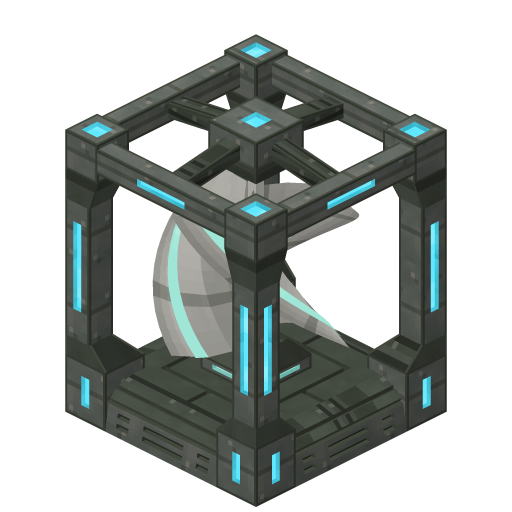
A wind generator you build from a core, seventeen housings and four posts. Its blades turn day and night, and storms make it stronger.
- Output
- 96 FE/t on average
- Buffer
- 20,000 FE
- Structure
- 3×3, 4 high
- Power leaves
- The bottom of the core
- Upgrades
- Tier kits
- ID
enthalpy:zephyr_core
What it does#
The Zephyr Spire turns wind into FE, burning nothing and needing no pipes. Unlike the sun, the wind never clocks off, so it works through the night.
It makes 96 FE/t on average, as much as a Helion Array in full sun. That's 2.4× what a Caloric Engine makes. The wind rises and falls, so the output swings above and below that.
Bad weather is good news here. Rain gives it a boost, and a thunderstorm doubles it. The Helion Array is the other way round, which makes the two a natural pair.
It costs a diamond a housing, and its vanes need  Aeolic Crystals. Those grow from breeze rods, so expect a trip to a trial chamber first.
Building it#
 Crafting Table


 Crafting Table


 Crafting Table
You need one Zephyr Core, seventeen Zephyr Housings and eight Machine Chassis. The core takes three Zephyr Vanes. The spire is a multiblock, 3×3 across and 4 blocks high.
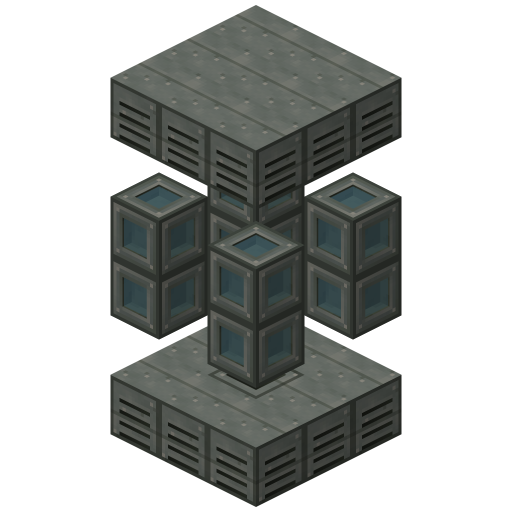
- Place the core where the middle of the base will be.
- Put a Zephyr Housing in each of the eight places round it, making the base a full 3×3.
- On each corner of the base, stack two Machine Chassis to make a post.
- Leave the rest of those two layers empty. The blades turn there.
- Lay nine housings across the tops of the posts to make a full 3×3 top.
- Wait a moment after the last block. The parts join into one frame, and the blades start to turn.
Place the core first. Until the spire is finished, the core shows a faint ghost of each missing part, and a red outline marks anything in the way.
The blades need all ten empty blocks in the middle layers. A torch, a slab or a stray block of dirt in there stops the spire from forming, and its screen says Blades blocked instead of Incomplete.
Break any part and the spire comes apart at once. Use any housing or post and it opens the core's screen.
A Machine Chassis can belong to only one machine. One that's already part of an Ecotone, a Helion Array or a Heliokiln can't be a post.
Using it#
Open it from the core, or from any housing or post. The screen below is a base spire on a clear day, with the wind fairly strong. Click the tabs and they behave like the real thing.

- Base of a Zephyr Spire, 3x3 and 4 high: Zephyr Housings round it and across the top
- Two Machine Chassis up each corner. Keep the middle empty for the blades
- Output follows the wind, the same for every spire in the dimension. Rain and storms add to it
- Needs open sky over its top. FE leaves from underneath
- 1This is the spire's buffer, where power waits before it leaves. It fills while the blades turn and empties as a busbar or machine takes some. A full buffer makes nothing, so make sure something is drawing from it.
- 2Look here to see that it's working. Running means it's making power. Idle means the buffer is full or the sky is covered. Disabled means redstone has switched it off. Incomplete means a part is missing, and Blades blocked means something is in the middle.
- 3This is what the spire is up to. It shows what it makes now beside its average, and the buffer. Then come the wind's strength, the weather (Clear, Rain or Storm) and whether the sky over the top is Open.
- 4Put a tier kit here. It raises the output and the buffer.
- 5These show the tier, the average output, the range the gusts swing it through in clear weather, and the buffer.
- 6Auto-output pushes power out of the bottom of the core. The usual redstone switch sits below it. The spire has no Sounds or Auto-input switches and no side panel, because it only gives from below.
Getting the power out#
Power leaves through the bottom of the core, and only there. Nothing else on the spire takes or gives FE.
Under the core sits an output port with a glowing lamp, flat on the ground. A busbar in the block below plugs straight into it, and a machine, a cell or a vault port works there too.
The core can push out up to 1,000 FE/t at the base tier. That's far more than it makes, so the output limit never gets in the way.
Wind and weather#
The wind picks a new strength every 2 minutes and eases towards it. It evens out over time, so the spire averages 96 FE/t.
| Weather | Output | Dead calm | Average | Full gale |
|---|---|---|---|---|
| Clear | ×1 | 64 FE/t | 96 FE/t | 128 FE/t |
| Rain or snow | ×1.5 | 96 FE/t | 144 FE/t | 192 FE/t |
| Thunderstorm | ×2 | 128 FE/t | 192 FE/t | 256 FE/t |
Night makes no difference. Neither does height, so a spire on the ground does as well as one on a mountain top. Save yourself the climb.
The one thing it needs is open sky over the middle of its top. A roof or a tree over the hub stops it dead, but the rest of the top can be shaded.
Every spire in a dimension feels the same wind. Building a second one doubles your power, but both lull and gust together. Rain only counts where it can fall, so a desert spire never gets the boost.
Upgrades#
A tier kit is an upgrade item you slot into a machine. On the spire it works as it does on an engine, multiplying output and the buffer.
| Tier | Kit | Average output | Buffer |
|---|---|---|---|
| Base | None | 96 FE/t | 20,000 FE |
| Tempered |  Tempered Upgrade Kit | 192 FE/t | 40,000 FE |
| Fortified |  Fortified Upgrade Kit | 288 FE/t | 80,000 FE |
| Luminous |  Luminous Upgrade Kit | 384 FE/t | 160,000 FE |
| Harmonic |  Harmonic Upgrade Kit | 576 FE/t | 320,000 FE |
The spire takes no modules. There's no fuel to save, and the wind already blows all night.
Good to know#
- The blades wind up slowly to the wind's pace, and run down when the spire stops.
- Pale dust whirls round the blades, thicker as the wind picks up.
- With Jade installed, the core shows what it's making, the wind's strength, and whether its top can't see the sky.
- The lit strips give off a little light.
How it works#
- The core checks the structure once a second. That's why the frame forms a moment after the last part goes in.
- It looks at the weather and the sky every 2 s, so it follows a change a moment late.
- The wind runs from 0 to 100%. At 50% the spire makes its average. Each 50% either way moves it by 33% of the average.
- Output is the average, moved by the wind, then times the weather's multiplier from the table. With the sky covered, it is nothing.
- A full buffer makes nothing.
For pack makers: the settings behind these numbers
| Setting | Default | Range | What it does |
|---|---|---|---|
zephyrSpire. | 96 | 0 to no limit | FE/t a Zephyr Spire makes on average in clear weather, before its kit's rate multiplier |
zephyrSpire. | 0.3333 | 0 to 1 | How far the wind swings its output either side of the average, as a share of it: a third gives 64 to 128 FE/t |
zephyrSpire. | 1.5 | 1 to 10 | Its output while it rains or snows on it, times its clear-weather output |
zephyrSpire. | 2 | 1 to 10 | Its output in a thunderstorm, times its clear-weather output |
zephyrSpire. | 20,000 | 1 to no limit | FE its core holds, before its kit's capacity multiplier |
zephyrSpire. | 1,000 | 1 to no limit | Most FE/t its core pushes out of its underside, before its kit's capacity multiplier |
upgrades. | 1 / 2 / 3 / 4 / 6 / 8 / 10 / 12 | Energy rate (and therefore speed) multiplier per tier: base, tempered, fortified, luminous, harmonic, allthemodium, vibranium, unobtainium | |
upgrades. | 1 / 2 / 4 / 8 / 16 / 20 / 24 / 32 | Energy buffer and transfer multiplier per tier: base, tempered, fortified, luminous, harmonic, allthemodium, vibranium, unobtainium |
The kit multiplies the average output by the tier's rate multiplier, and the buffer and output limit by its capacity multiplier, as it does for an engine. The wind's swing and the weather apply after that.
Related#
- Choosing an engine and fuel
- Helion Array: power from the sun, the spire's day-shift partner
- Leyden Busbar: from the core to the rest of a base
- Machine Chassis: the posts
- Aeolic Crystal: what the vanes need
- Upgrades and modules