
Helion Array
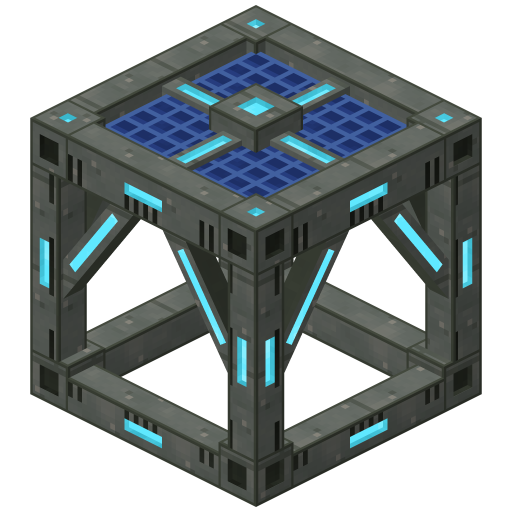
A solar generator, built from a core, eight panels and four legs, that turns daylight into power without burning a thing.
- Output
- 96 FE/t in full sun
- Buffer
- 20,000 FE
- Structure
- 3×3×3 multiblock
- Power leaves
- The bottom of the core
- Upgrades
- Tier kits, and a Lumen Module for night power
- ID
enthalpy:helion_core
What it does#
The Helion Array turns sunlight into FE. It burns nothing and needs no pipes. Think of it as a generator that works the day shift and never asks for lunch.
In full sun it makes 96 FE/t. That's 2.4× what a Caloric Engine makes. It's enough to run about 5 basic machines at once, before any upgrades.
It costs diamonds, two a panel, so it comes after your first engines. The payoff is power you'll never have to refuel. Pair it with a Voltaic Cell or a Leyden Vault, and the day's sun carries your base through the night.
Building it#
 Crafting Table


 Crafting Table


You need one Helion Core, eight Helion Panels and eight Machine Chassis. The array is a multiblock, a 3×3×3 cube with a lot of gaps.
- Place the core in the middle of the top layer.
- Put a Helion Panel in each of the eight places round it. The top layer is now a full 3×3.
- Under each of the four corners, stack two Machine Chassis to make a leg.
- Leave the middle empty. That's where your power cable goes.
- Place the last part and wait a moment. The blocks join into one frame and the strips light up.
- Place a Leyden Busbar, a slim power cable, in the empty space right under the core.
- Run more busbars from there out through the open side of the frame, past the legs, to your machines.
That's all the setup there is. The bottom of the core is already set to push power out. A busbar matches it by itself, so power flows as soon as the sun is up.
Place the core first. Until the array is finished, the core shows a faint ghost of each missing part, and a red outline marks anything in the way. Build to the picture.
Break any part and the array comes apart at once. Use any panel or leg and it opens the core's screen, so you can reach it from anywhere on the frame.
Don't use a Machine Chassis that's already part of an Ecotone, the fish-farm multiblock, a Zephyr Spire or a Heliokiln as a leg.
Using it#
Open it from the core, or from any panel or leg. Click the tabs below and they'll behave like the real screen. This one's a base array on a clear day, with a  Lumen Module fitted, a module that keeps some power coming at night. Only 8 of its 9 top blocks can see the sky.

- Hub of a Helion Array: eight Helion Panels round it, two Machine Chassis legs under each corner
- Place the core up top first. It shows the parts still to place
- Makes FE in daylight, less in rain and storms. At night, only a Lumen module gets some
- FE leaves from underneath
- 1The array's buffer, where power waits before it leaves. It fills while the sun shines and empties as a busbar or machine takes some. A full buffer makes nothing, so make sure something is drawing from it.
- 2Look here to see that it's working. Running means it's making power. Idle means it's night with no Lumen Module, or the buffer is full. Disabled means redstone has switched it off. Incomplete means a part is missing.
- 3What the array is up to. It shows what it makes now beside what it would make in full sun. It also shows the buffer and the time of day: Day, Night or Moonlit. Next come the weather (Clear, Rain or Storm) and how many of the nine top blocks see the sky.
- 4Put a tier kit here. It raises full-sun output and the buffer.
- 5Put a Lumen Module here, and the array keeps 25% of its output going at night.
- 6These show the tier, what the array makes in full sun, how much it keeps at night (nothing without a Lumen Module) and the buffer.
- 7Auto-output pushes power out of the bottom of the core. The usual redstone switch sits below it. The array has no Sounds or Auto-input switches, because it's silent and takes nothing in. It has no side panel either, since it only gives from below.
Getting the power out#
Power leaves through the bottom of the core, and only there. Nothing else on the array takes or gives FE.
The bottom of the core is a glowing socket that a busbar plugs straight into. You're not stuck with a busbar, either. A machine, a cell or a vault port can sit in the gap too, touching the core from below.
The core can push out up to 1,000 FE/t at the base tier. That's far more than it makes, so the output limit never gets in the way.
Getting the most from it#
It makes the most power in clear daylight with open sky above it. Rain, night and anything over the top cut that down. The table shows by how much.
| Light | Share of full sun |
|---|---|
| Clear day | 100% |
| Rain or snow | 50% |
| Thunderstorm | 25% |
| Night (the readout says Night) | 0% |
| Night with a Lumen Module (the readout says Moonlit) | 25% |
The sky above the top layer matters too. The nine top blocks are the core and the eight panels round it. Each one that sees the sky is worth a ninth of the output. A day can go something like this.
- Clear day, all nine open: 96 FE/t.
- A tree shades three of them: 64 FE/t.
- Then it rains: 32 FE/t.
Rain and night stack. A stormy night with a Lumen Module keeps only about 6% of full sun. Deserts never get rain, so a desert array never loses power to the weather.
The glowing strips on the frame show how it's doing at a glance.
| Strips | Meaning |
|---|---|
| Unlit | It makes nothing |
| Dim | It makes some power, but under three quarters of full sun |
| Bright | Three quarters of full sun or more |
| Moonlit blue | Night, with a Lumen Module, while it makes power |
Upgrades#
A tier kit is an upgrade item you slot into a machine. On the array it works as it does on an engine, multiplying output and the buffer.
| Tier | Kit | Full-sun output | Buffer |
|---|---|---|---|
| Base | None | 96 FE/t | 20,000 FE |
| Tempered |  Tempered Upgrade Kit | 192 FE/t | 40,000 FE |
| Fortified |  Fortified Upgrade Kit | 288 FE/t | 80,000 FE |
| Luminous |  Luminous Upgrade Kit | 384 FE/t | 160,000 FE |
| Harmonic |  Harmonic Upgrade Kit | 576 FE/t | 320,000 FE |
- Lumen Module · up to 1
There are no Celerity or Economizer modules, because there's no fuel to save. The one module is the Lumen Module, which keeps 25% of the output going at night. The core takes one.
Crafting Table

Good to know#
- The array stops, and goes dark, when its buffer is full. It doesn't waste light.
- With Jade installed, the core shows what it's making and how many of its top blocks are open to the sky.
- The lit strips give off a little light.
How it works#
- The core checks the structure once a second. That's why the frame forms a moment after the last part goes in.
- It looks at the light every 2 seconds, so it follows the weather a moment late.
- Output is full-sun output, times the light's share from the table, times the share of the nine top blocks that see the sky.
- The array takes one Lumen Module.
- A full buffer makes nothing, and the strips go out with the output.
For pack makers: the settings behind these numbers
| Setting | Default | Range | What it does |
|---|---|---|---|
helionArray. | 96 | 0 to no limit | FE/t a Helion Array makes in full sun with every top block open to the sky, before its kit's rate multiplier |
helionArray. | 20,000 | 1 to no limit | FE its core holds, before its kit's capacity multiplier |
helionArray. | 1,000 | 1 to no limit | Most FE/t its core pushes out of its underside, before its kit's capacity multiplier |
helionArray. | 0.25 | 0 to 1 | Share of its daytime output it keeps at night with a Lumen module; none without one |
helionArray. | 0.5 | 0 to 1 | Share of its output it keeps while it rains or snows on it |
helionArray. | 0.25 | 0 to 1 | Share of its output it keeps in a thunderstorm |
upgrades. | 1 / 2 / 3 / 4 / 6 / 8 / 10 / 12 | Energy rate (and therefore speed) multiplier per tier: base, tempered, fortified, luminous, harmonic, allthemodium, vibranium, unobtainium | |
upgrades. | 1 / 2 / 4 / 8 / 16 / 20 / 24 / 32 | Energy buffer and transfer multiplier per tier: base, tempered, fortified, luminous, harmonic, allthemodium, vibranium, unobtainium |
The kit multiplies full-sun output by the tier's rate multiplier, and the buffer and output limit by its capacity multiplier, as it does for an engine.
Related#
- Choosing an engine and fuel
- Leyden Busbar: from the core to the rest of a base
- Leyden Vault: store the daytime surplus
- Heliokiln: the sun's heat, for melting
- Machine Chassis: the legs
- Upgrades and modules