
Heliokiln
A solar crucible, built from a core, eight mirrors, a port and four legs, that melts stone into lava and salt into molten salt on sunlight alone.
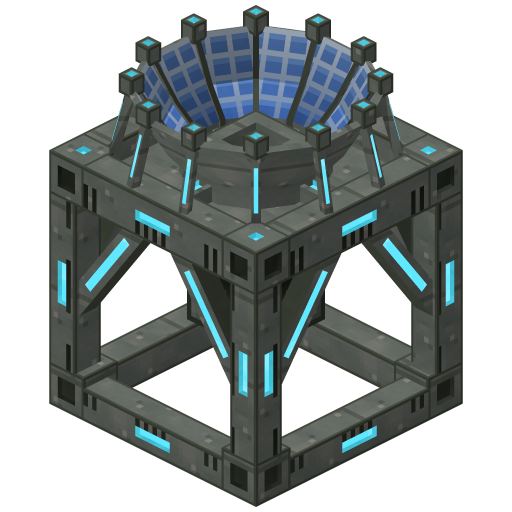
- Makes
- Lava from stone, molten salt from salt
- Heat
- 1 a tick in full sun
- Tank
- 8,000 mB
- Structure
- 3×3×3 multiblock
- Power
- None needed
- Upgrades
- Tier kits
- ID
enthalpy:heliokiln_core
What it does#
The Heliokiln melts things with sunlight. A dish of mirrors focuses the sun onto a crucible, and the crucible melts whatever you drop in. No fuel, no power, no bills.
It makes two things.  Cobblestone and
 Netherrack melt into lava.
 Salt and
 Salt Block melt into molten salt. That's lava for an Igneous Engine or a Vortex Separator. It's also molten salt for a Brine Accretor, with no lava spent to make it.
Like a Helion Array, it only works the day shift.
Building it#
 Crafting Table


 Crafting Table


 Crafting Table


You need one Heliokiln Core, eight Heliokiln Mirrors, one Heliokiln Port and eight Machine Chassis for the legs. The core and the port take a Machine Chassis each to craft, so that's ten in all. The Heliokiln is a multiblock, a 3×3×3 cube with gaps.
- Place the core in the middle of the top layer.
- Put a Heliokiln Mirror in each of the eight places round it. The top layer is now a full 3×3.
- Place the Heliokiln Port in the middle, right under the core.
- Under each of the four corners, stack two Machine Chassis to make a leg.
- Leave the rest open. That's where the pipes and hoppers go.
- Place the last part and wait a moment. The blocks join into one frame, and the mirrors curve up into a dish round the crucible.
Place the core first. Until the Heliokiln is finished, the core shows a faint ghost of each missing part, and a red outline marks anything in the way. Build to the picture.
Break any part and the whole thing comes apart at once. Use any mirror, the port or a leg and it opens the core's screen, so you can reach it from anywhere on the frame.
Don't use a Machine Chassis that's already part of an Ecotone, a Helion Array or a Zephyr Spire as a leg. A chassis can only belong to one of them.
Using it#
Open it from the core, a mirror, the port or a leg. Click the tabs below and they'll behave like the real screen. This one's a base Heliokiln on a clear day with all nine top blocks open. It's melting cobblestone, and the tank is a third full of lava.
Heliokiln CoreRunning32
- Crucible of a Heliokiln: mirrors round it, its port below, chassis legs under the corners
- Melts stone into lava and salt into molten salt, on sunlight alone
- Netherrack goes four times as far. Rain slows it; night stops it
- Drop things in the top, or pipe them through the port
Side ConfigInputOutputBothNone- 1Look here to see that it's working. Running means something is melting. Idle means nothing is, or it's night, or the tank is full. Disabled means redstone has switched it off. Incomplete means a part is missing.
- 2The melt waits here. Hover it for the exact amount. It holds one fluid at a time, so a Heliokiln that holds lava won't melt salt until you drain it.
- 3Drop what you want to melt here. It takes only things the Heliokiln can melt. Item pipes and hoppers can fill it too.
- 4The heat the item in the crucible has gathered. When the bar is full, the item melts into the tank.
- 5What the crucible is up to. Heat is how fast it gathers heat now, against full sun. Next melt is the time until the item melts. Then come the time of day, the weather and how many of the nine top blocks see the sky.
- 6Put a tier kit here to melt faster.
- 7These show the tier, the melt speed and the tank's size.
- 8Auto-output pushes the melt out of the port's output faces. The Sounds toggle mutes the bubbling. The usual redstone switch is here too. It has no Auto-input switch, since items only go in.
What it melts#
Each melt needs a set amount of heat. In full sun the Heliokiln gathers 1 heat a tick, so the times below are for a clear day with a base kit.
| Put in | Makes | Amount | Heat needed | Time in full sun | mB a second |
|---|---|---|---|---|---|
| Cobblestone | Lava | 100 mB | 250 | 12.5 s | 8 |
| Netherrack | Lava | 400 mB | 1,000 | 50 s | 8 |
| Salt Block | Molten Salt | 1,000 mB | 625 | 31.2 s | 32 |
| Salt | Molten Salt | 250 mB | 156 | 7.8 s | 32.1 |
Cobblestone also means mossy cobblestone and cobbled deepslate.
Netherrack gives four times the lava of a cobblestone, and takes four times as long. Salt melts far cooler than rock, so it goes four times as fast and gives four times the fluid a second.
- The item sits in the crucible and takes heat a little at a time. Swap it for a different melt and the count starts again.
- A part-melted item keeps its heat through a save and a reload.
- If the tank is full, or holds a different fluid, a finished melt waits for room.
- It melts one item at a time, so keep the input fed. A hopper over the crucible does the job.
 100 mB400 mB
The port#
The block under the core is the Heliokiln Port. It's how pipes, conduits and hoppers reach the crucible. Its four sides, between the legs, and its bottom are the Heliokiln's faces. Set each one on the core's screen, as you would on any machine.
The Top is set to Disabled. The Bottom is set to Output, so it gives the melt. Every other face is set to Input & Output, so it takes items and gives the melt. Auto-output is on, and Auto-input is off.
- Items go in at the port's sides. They're only taken if a melt uses them.
- The melt comes out of the sides and the bottom. Pipes pull it out, or turn on auto-output to push it into a tank or pipe.
- The port's top meets the core, so it's off.
- The core's own top takes items too, like a hopper over the crucible.
- The melt can only be taken out. Nothing can be poured in.
Side configuration explains faces, modes and redstone control for every machine.
A good set-up puts a Bulkhead Tank or an Igneous Engine under the port and a hopper above.
Sun, rain and night#
The Heliokiln follows the sky as a Helion Array does. It gathers the most heat on a clear day, less in bad weather, and none at night.
| Light | Share of full sun |
|---|---|
| Clear day | 100% |
| Rain or snow | 50% |
| Thunderstorm | 25% |
| Night (the readout says Night) | 0% |
The sky above the top layer matters too. Each of the nine top blocks that sees the sky is worth a ninth. Follow one cobblestone through a day of bad luck.
- Clear day, all nine open: a cobblestone melts in 12.5 s.
- A tree shades three of them: 18.8 s.
- Then it rains: 37.5 s.
The crucible stops heating at night. Heat already gathered stays, so a melt picks up where it left off at sunrise. Deserts never get rain, so a desert Heliokiln never loses heat to weather. Unlike the array, it has no Lumen Module for the night.
The frame's strips glow with the sun, as the array's do. They go out at night, and the dish's mirrors flash gold while there's light to catch.
Upgrades#
A tier kit is an upgrade item you slot into a machine. In the Heliokiln it multiplies the heat it gathers, so everything melts faster.
| Tier | Kit | Heat in full sun |
|---|---|---|
| Base | None | 1 heat/t |
| Tempered |  Tempered Upgrade Kit | 2 heat/t |
| Fortified |  Fortified Upgrade Kit | 3 heat/t |
| Luminous |  Luminous Upgrade Kit | 4 heat/t |
| Harmonic |  Harmonic Upgrade Kit | 6 heat/t |
It takes no modules, since there's no power to save and nothing to feed or filter. The tank stays at 8,000 mB at every tier.
The look#
Once formed, the Heliokiln is quite a sight. The mirrors become a dish of twelve blue panels curving up from the crucible, each in two bands, over a silver grid. A post rises at each point of the dish's rim, a lamp sunk in its top and a lit strut holding it up from the frame.
- By day, gold glints gather on each panel, and a beam drops from each over the rim into the crucible. A flare breathes where they meet. It's fainter in rain and fades as the sun sets.
- The crucible shows the melt, rising as the tank fills. It crusts dark while the sun is off it.
- While it melts, the core smokes and throws lava sparks, bubbling as it goes. The Sounds toggle on its screen mutes the bubbling.
- The port is lit orange at its front.
Good to know#
- A Heliokiln that's full or has nothing to melt sits there quietly and wastes nothing.
- With Jade installed, the core shows how many of its top blocks are open to the sky and how far through a melt it is.
- JEI has a page of its melts, with the time each takes in full sun.
- The lit strips give off a little light.
How it works#
- The core checks the structure once a second. That's why the frame forms a moment after the last part goes in.
- It looks at the light every 2 seconds, so it follows the weather a moment late.
- Heat a tick is full-sun heat, times the kit's multiplier, times the light's share from the table, times the share of the nine top blocks that see the sky.
- The item in the crucible takes that heat every tick. When it has had its recipe's heat, it melts and the tank fills.
- A melt waits while the tank holds another fluid or has no room.
For pack makers: the settings behind these numbers
| Setting | Default | Range | What it does |
|---|---|---|---|
heliokiln. | 1 | 0 to 1,000 | Heat a Heliokiln gathers a tick in full sun with every top block open to the sky, before its kit's rate multiplier; each melt's recipe says how much it needs (cobblestone 250, for 100 mB of lava) |
helionArray. | 0.5 | 0 to 1 | Share of its output it keeps while it rains or snows on it |
helionArray. | 0.25 | 0 to 1 | Share of its output it keeps in a thunderstorm |
upgrades. | 1 / 2 / 3 / 4 / 6 / 8 / 10 / 12 | Energy rate (and therefore speed) multiplier per tier: base, tempered, fortified, luminous, harmonic, allthemodium, vibranium, unobtainium |
Each melt is a recipe of type enthalpy:heliokiln: an input, a fluid result and the heat it needs. Add your own with a datapack. The kit multiplies the heat gathered by its tier's rate multiplier.
Rain and storm shares are the Helion Array's settings, shared by both machines.
Related#
- Helion Array: sunlight into power
- Vortex Separator: uses lava for gasoline and steam
- Igneous Engine: burns lava
- Brine Accretor: grows crystals from molten salt
- Making salt and molten salt
- Machine Chassis: the legs
- Upgrades and modules