
Tidewheel
A water-current generator you build in a river or the sea. Its wheel turns day and night, in any weather, with no sky needed.
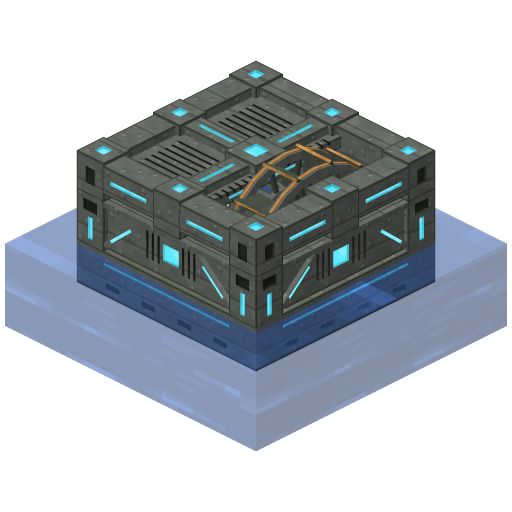
- Output
- 256 FE/t on average
- Buffer
- 50,000 FE
- Structure
- 5×5, 3 high, in water
- Power leaves
- The gearbox, and a socket under the hub
- Upgrades
- Tier kits
- ID
enthalpy:tidewheel_core
What it does#
The Tidewheel turns a river's current, or the sea's tide, into FE. A big wheel churns through the water inside a stone platform, burning nothing and needing no pipes.
It makes 256 FE/t on average. That's 2.7× a Helion Array in full sun, and 6.4× what a Caloric Engine makes.
What makes it special is that it never stops. Night, rain and a roof overhead make no difference, because water keeps flowing whatever the sky is doing.
The catch is size. It takes 50 housings, plus a river or a stretch of sea to stand in.
Building it#
 Crafting Table


 Crafting Table


 4
You need one Tidewheel Core, fifty Tidewheel Housings and four Machine Chassis. The core takes a Nautilus Shell, which a Brinestone Angler brings up from its fishing.
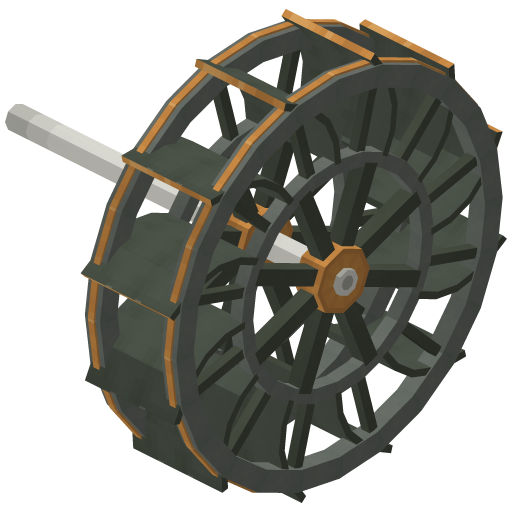
The wheel is a multiblock, 5×5 across and 3 blocks high. Build it standing in a river or the sea, with the bottom layer in the water. The wheel turns in the west half, and the deck and gearbox sit in the east half.
- Place the core in the middle of the middle layer. It's the wheel's hub.
- Lay a 5×5 ring of housings in the water for the bottom layer, a block below the core.
- Put a Machine Chassis on each corner of that ring. These are the posts.
- Fill in the middle layer's ring between the posts with housings. Its middle block on the east side becomes the gearbox.
- Lay a full 5×5 ring of housings for the top layer.
- Inside the top ring, fill the east half with six more housings: two rows of three. The middle one, over the core, becomes the hub cap.
- Wait a moment after the last block. The parts join into one platform, and the wheel starts to turn.
Place the core first. Until the wheel is finished, the core shows a faint ghost of each missing part, and a red outline marks anything in the way.
The housings hold water, so the bottom ring stays wet when you place it in a river. Break one and its water stays put.
Water and room for the wheel#
The wheel dips below the platform into the water and rises just over its top. So it needs water under it and empty space above it.
| Where | Must be | Otherwise the screen says |
|---|---|---|
| The west column inside the bottom ring, under the wheel (3 blocks) | Water | Race dry |
| Under the platform's west half, a block below the bottom layer (6 blocks) | Water | Race dry |
| The west column inside the middle and top rings (6 blocks) | Empty | Wheel blocked |
| Above the platform's west half, a block over the top layer (6 blocks) | Empty | Wheel blocked |
| The block east of the core, where the axle runs | Empty | Wheel blocked |
In short, the wheel's side needs water two deep below and clear air above. Once it forms, any flowing water under the wheel is set still and stays that way, so the sea won't wash sideways through the wheel.
Break any part and the wheel comes apart at once. Use any housing or post and it opens the core's screen.
A Machine Chassis can belong to only one machine. One that's already part of an Ecotone, a Helion Array, a Zephyr Spire or a Heliokiln can't be a post.
Using it#
Open it from the core, or from any housing or post. The screen below is a base wheel in the sea, at the height of a spring flood tide, in calm weather. Click the tabs and they behave like the real thing.

- Hub of a Tidewheel: housing rings on all three layers, a deck over the east half
- Chassis at the middle corners. The wheel churns in the west half
- Rivers run steady; the sea ebbs and floods with the moon. Storms whip it up
- Crowded wheels share the current. FE leaves by the gearbox or under the hub
- 1This is the wheel's buffer, where power waits before it leaves. It fills while the wheel turns and empties as a busbar or machine takes some. A full buffer makes nothing, so make sure something is drawing from it.
- 2Look here to see that it's working. Running means it's making power. Idle means the buffer is full or there's no current. Disabled means redstone has switched it off. Incomplete, Race dry or Wheel blocked means it hasn't formed.
- 3This is what the wheel is up to. It shows what it makes now beside its average, and the buffer. Then come its water (River, Sea, Still or Too little), and in the sea the tide and the moon. Last come the weather and whether the current is its own or shared.
- 4Put a tier kit here. It raises the output and the buffer.
- 5These show the tier, the average output, the range the spring tides swing it through at sea, and the buffer.
- 6Auto-output pushes power out of the gearbox and the socket under the hub. The usual redstone switch sits below it. The wheel has no Sounds or Auto-input switches and no side panel.
Getting the power out#
Power leaves in two places, and nowhere else.
- The gearbox: the middle of the east wall, with a glowing lamp on its outer face. A busbar or a machine against that face takes power.
- The socket under the hub: the bottom of the core. The block under it is open water, so a busbar can come up through the water to plug in.
The other faces of the hub give nothing. The core can push out up to 2,000 FE/t at the base tier, far more than it makes.
Rivers, seas and tides#
The wheel's biome sets its current. The water round it only has to be there, not flowing.
| Water | Lowest | Average | Highest |
|---|---|---|---|
| River | 256 FE/t | 256 FE/t | 256 FE/t |
| Sea, full or new moon (spring tides) | 128 FE/t | 256 FE/t | 384 FE/t |
| Sea, crescent or gibbous moon | 147 FE/t | 256 FE/t | 365 FE/t |
| Sea, half moon (neap tides) | 192 FE/t | 256 FE/t | 320 FE/t |
| Anywhere else (still water) | 0 | 0 | 0 |
A river runs steady, all day and all night. The sea has two tides a day. The current floods in from sunrise to noon, ebbs out from noon to sunset, and does the same again through the night. It's fastest in between, and slack around sunrise, noon, sunset and midnight.
The wheel turns with the flood, then the other way on the ebb. Output peaks at full flood and full ebb and dips through slack water, but it never drops to nothing. Either way, the sea averages the same as a river, so pick whichever view you like better.
The moon sets how far the tide swings. The screen says Spring tides at the full and new moons, Neap tides at the half moons, and Between at the crescent and gibbous moons in the middle.
Storms and neighbours#
- A thunderstorm raises rivers and seas alike, by ×1.25. Plain rain does nothing.
- Other formed Tidewheels within 12 blocks share the current. Two wheels each make half, three a third, and so on. Space them out.
- It needs open water round it. Of the 81 blocks round and under its bottom layer, at least 32 must be water. Otherwise the screen says Too little, so a bucket poured into a river biome won't fool it.
The deck#
You can stand on the deck over the east half. It's three quarters of a block high, with the cross beams a little higher and the hub cap a full block. A Brinestone Angler can stand on it and fish too, so your power station doubles as a fishing pier.
Upgrades#
A tier kit works as it does on an engine, multiplying the output and the buffer.
| Tier | Kit | Average output | Buffer |
|---|---|---|---|
| Base | None | 256 FE/t | 50,000 FE |
| Tempered |  Tempered Upgrade Kit | 512 FE/t | 100,000 FE |
| Fortified |  Fortified Upgrade Kit | 768 FE/t | 200,000 FE |
| Luminous |  Luminous Upgrade Kit | 1,024 FE/t | 400,000 FE |
| Harmonic |  Harmonic Upgrade Kit | 1,536 FE/t | 800,000 FE |
The wheel takes no modules.
Good to know#
- The wheel winds up slowly to its pace, and runs down when it stops. At sea it slows through slack water and swings round as the tide turns.
- Spray flies where the blades cut the water, with bubbles churning between.
- With Jade installed, the core shows what it's making. It also says when there's no current or the current is shared, and why an unformed wheel won't form.
- The lit strips give off a little light.
How it works#
- The core checks the structure once a second. That's why the platform forms a moment after the last part goes in.
- It looks at its water, the weather and its neighbours every 5 s. The tide itself follows the time of day and the moon.
- In the sea, output is the average times 1 + swing × (2 × flow² − 1). The flow runs from 1 at full flood through 0 at slack to −1 at full ebb. The swing runs from the neap figure at the half moons to the spring figure at full and new moon.
- That, times the storm's multiplier, divided among the wheels sharing the current, is what it makes. A full buffer makes nothing.
For pack makers: the settings behind these numbers
| Setting | Default | Range | What it does |
|---|---|---|---|
tidewheel. | 256 | 0 to no limit | FE/t a Tidewheel makes in a river, and on average over the tides in the sea, before its kit's rate multiplier |
tidewheel. | 0.5 | 0 to 1 | How far the spring tides at full and new moon swing a sea wheel's output either side of the average, as a share of it: a half gives 128 to 384 FE/t |
tidewheel. | 0.25 | 0 to 1 | The same at the neap tides of the half moons |
tidewheel. | 1.25 | 1 to 10 | Its output in a thunderstorm, which raises rivers and seas alike, times its output in calm weather |
tidewheel. | 12 | 0 to 64 | Blocks within which other Tidewheels share its current: each one nearby divides it by one more |
tidewheel. | 32 | 0 to 81 | Of the 81 blocks round its bottom layer and under it, how many must be water for it to find a current |
tidewheel. | 50,000 | 1 to no limit | FE its core holds, before its kit's capacity multiplier |
tidewheel. | 2,000 | 1 to no limit | Most FE/t it pushes out of its gearbox and the socket under its hub, before its kit's capacity multiplier |
upgrades. | 1 / 2 / 3 / 4 / 6 / 8 / 10 / 12 | Energy rate (and therefore speed) multiplier per tier: base, tempered, fortified, luminous, harmonic, allthemodium, vibranium, unobtainium | |
upgrades. | 1 / 2 / 4 / 8 / 16 / 20 / 24 / 32 | Energy buffer and transfer multiplier per tier: base, tempered, fortified, luminous, harmonic, allthemodium, vibranium, unobtainium |
The kit multiplies the average output by the tier's rate multiplier, and the buffer and output limit by its capacity multiplier, as it does for an engine. The tide, the storm and sharing apply after that. Rivers and seas are the biome tags minecraft:is_river and minecraft:is_ocean.
Related#
- Choosing an engine and fuel
- Helion Array and Zephyr Spire: power from the sun and the wind
- Leyden Busbar: from the gearbox to the rest of a base
- Machine Chassis: the posts
- Brinestone Angler: brings up nautilus shells, and fishes from the deck
- Upgrades and modules