
Ecotone
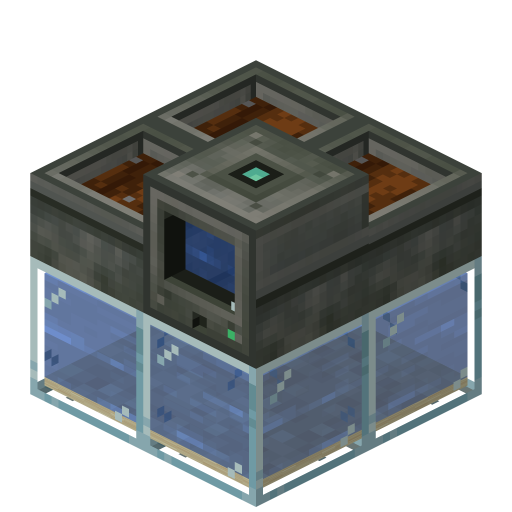
An aquaponics multiblock where pairs of fish and a few crops feed each other, farming resources, produce and more fish.
- Power
- 60 FE/t by day, double at night
- Water
- 50 mB per tick
- Water tank
- 8,000 mB
- Buffer
- 20,000 FE
- Structure
- 2×2×2 multiblock
- Upgrades
- Kits, modules
- ID
enthalpy:ecotone
What it does#
The Ecotone is a small farm and fish tank in one. Pairs of fish breed more fish, and a few crops grow beside them. The fish keep the crops fed and the crops keep the water clean, so the more they are in balance, the better both do.
What comes out depends on what you put in:
- Resource fish yield a material each time a pair breeds: iron nuggets, copper, amethyst and many more. This is what the Ecotone is for.
- Vanilla fish just breed more of themselves. Raw cod and salmon from an Ecotone feed the Triturator, which grinds fish into
 Fish Meal.
 - Crops grow on their own timer and come out as produce and seeds, with one item kept back to replant.
For example, a pair of  Ferric Cod breeds once every 10 s at the base tier. About 9.91% of the time that gives another Ferric Cod. Otherwise there is a 66% chance of an
  Iron Nugget. A new pair of fish comes from the Spawning Basin; see breeding and mutation.
Building it#
 Crafting Table


The Ecotone is a multiblock, two blocks wide, two deep and two tall. The controller is the Ecotone block itself, and it can be any corner of the top layer.
- Place a flat 2×2 of four blocks: the Ecotone and three Machine Chassis.
- Put four glass blocks in a 2×2 directly beneath them. Plain and stained glass both work, and so do most glass blocks from other mods.
- Wait about a second. The structure checks itself once a second, and when it is complete the chassis become planter beds, a water window opens in the front and the glass becomes the tank.
While it is unfinished, the Ecotone shows a faint ghost of each missing piece and a red outline where something is in the way. It previews the corner with the most pieces already in place, so you can start from any block.
Once built, the glass belongs to the Ecotone. Break a pane and the Ecotone comes apart: the pane drops as the glass it was and the rest turns back. A chassis or glass block that already belongs to another Ecotone does not count towards a second one, so two Ecotones cannot share parts. They can touch.
Using it#
An Ecotone runs when it has a pair of the same fish in one row and a crop planted. It works in four rows, and each row is a self-contained unit: its two fish on the left, its crop in the middle, then its outputs. Click the tabs below; they behave like the real screen.


 29
29 17128526
 3
3 714
714
- Top of a 2x2x2: this, plus 3 Machine Chassis
- Underneath: 4 glass blocks for the tank
- It works in 4 rows: 2 fish, a crop and its outputs
- Two of the same fish in a row breed one about every 10s
- Each crop yields like one and a half full 9x9 fields
- One crop item is replanted from every harvest
- Needs fish and a crop: each feeds the other
- More fish than crops: faster crops, slower breeding
- More crops than fish: faster breeding, slower crops
- Uses water and FE; pipe in water from an Aquifer
- After dark it needs a Lumen module, at 2x FE
- A full output pauses its row; a Void module clears overflow
- Feeder modules: +25% breeding each, but the fish eat 25% of the harvests; four eat them all
- Filtration modules: the reverse; four stop the fish. The two kinds cancel out
- Mutated fish yield resources instead of more fish
- Two of the same mutated fish sometimes breed another
- New species are bred in a Spawning Basin
- Set ports with a wrench on the structure's outer sides, top or tank
- A Kelp module floods the beds for kelp instead of land crops
- An Infusion module makes resource fish yield more
- Fish Meal in its slot: +50% resource yield; ground cod from one cod farm feeds three
- Fill adjacent Ecotones (Config tab): above half, it tops up emptier touching Ecotones; chains pass it along
- 1Running while the farm works. When it stops, the header says why: Build the tank, Needs a pair in a row, Needs a crop, Dark: needs Lumen, Needs water or Needs power. Disabled means redstone has switched it off.
- 2The FE it is spending each tick. When a row is blocked by a full output, this changes to say which kind of output is full.
- 3The Ecotone's store of power. It fills from a port set to input, and nothing else tops it up.
- 4The water tank. It fills from a water bucket or from a pipe into an input port, and it never gives the water back.
- 5Fish go in pairs across a row. Two fish of the same species breed; a Prized fish pairs with an ordinary one of its kind. Each slot takes one raw fish.
- 6How far the row's pair is towards its next breeding.
- 7The row's crop slot: a crop, seed or sapling-like plant item, one per slot. One is always kept back to replant.
- 8How far the crop is towards its next harvest.
- 9Fish output. New fish from a pair land here. A full stack stops that row breeding.
- 10Crop outputs, two per row. Produce and seeds. If both fill, that crop waits, ripe, until there is room.
- 11Resource output. What a resource fish yields lands here. If it is full, further yields are lost.
- 12The nutrients gauge. The line in the middle is balanced. Hover it for the current percentage and what it does to crops and breeding.
- 13Fish Meal. It feeds the fish, so resource yields can double while it lasts.
- 14The tier kit. It speeds the whole Ecotone up and opens the module slots beside it.
- 15Auto-output pushes finished items out through output ports. Fill adjacent Ecotones shares power and water with neighbours. The Ecotone has no side panel; faces are set as ports instead.
- 16The in-game Info tab carries a short version of this page.
Rows and breeding#
Every row has two fish slots, one on each side of a pair. Two fish of the same species breed one more every 10 s at the base tier. A mixed row does nothing, because the Ecotone has no catalyst slot: new species come from the Spawning Basin.
Each breeding rolls the species' yield (the numbers are on its species page):
- Vanilla fish and fish with no yield always give another of themselves, into the row's fish output.
- Resource fish give another of themselves some of the time, which is how a farm grows. Otherwise they roll their chance of the resource, which lands in the row's resource output. The odds differ a lot from species to species.
Breeding never uses up the pair. Take the new fish from the fish output and put them in an empty fish slot, and the farm grows with them. Remember that every fish also counts towards nutrients.
Crops#
Each of the four crop slots takes a plant item with a growth stage, which covers most crops: wheat, carrots, potatoes, beetroot, nether wart, and many modded ones. Melons and pumpkins are planted by their seeds, and the fruit comes out. Each crop is harvested every 24 s at the base tier into the row's two crop outputs, with seeds and bonus drops as the real crop would give. One item is kept back to replant, so a crop never runs out.
Stalks are the exception. Sugar cane, cactus, bamboo and anything else whose ripe block drops itself give two items per harvest and keep none back.  Kelp is one of these, and it is the only aquatic crop; see the Kelp Module.
A crop that does not suit the beds (kelp without the module, or a land crop with it) does not grow. It is not drawn in the tank and it does not count towards nutrients.
Nutrients#
An example first. Fill all eight fish slots with fish and plant two crops. The fish make plenty of waste, but only two crops take it up, so the water is rich: about 67% nutrients. Rich water speeds the crops up, to 1.17× the pace, and slows the fish, to 0.83×. A pair now breeds every 12 s instead of 10 s.
Turn it round: two fish and four crops is 20% nutrients, which is clear water. Breeding speeds up to 1.3× and the crops slow to 0.7×.
The rule behind it: nutrients are the share of the tank's balance that comes from fish. Each fish adds half a unit of waste, each crop takes up one unit, and nutrients are waste divided by waste plus uptake. A single pair per crop is exactly 50%.
- Between 40% and 60% the gauge reads Balanced. Below that it reads Clear water and above it Nutrient-rich.
- Crop growth is multiplied by one plus 0.5 times (two times nutrients, minus one). Breeding is multiplied by one minus the same amount.
- Every fish counts, paired or not, and every crop that can grow counts. It is the whole tank, not one row.
So more fish than crops favours crops, and more crops than fish favours fish. For a resource farm that wants more breedings, add crops; for a produce farm, add fish. A balanced tank is the safe middle, and the tuning guide goes into this in depth.
Running costs#
An Ecotone spends 60 FE/t and 50 mB of water every tick at the base tier, while it works. Both scale with the tier kit, so a faster Ecotone is a hungrier one: see Upgrades.
Its tank holds 8,000 mB, which is only 8 s of water at that rate, and its buffer a little over 17 s of power. Feed it from a steady supply. One base Aquifer makes 250 mB per tick, enough for 5 base-tier Ecotones.
It also needs light. After dark (and in dimensions with no day) it stops with Dark: needs Lumen unless it has a Lumen Module. With one it carries on, but at double the FE.
Full outputs#
Fish and crop outputs are checked separately every tick.
- A full fish output pauses that row's breeding. The header reads Fish outputs full.
- A full crop output pauses that crop. It stays ripe until you make room, and the header reads Crop outputs full. Both at once read Outputs full.
- A full resource output does not pause anything. Yields that do not fit are lost, by design. So is a Prized fish with nowhere to go, which arrives as an ordinary one.
Plan for it: pull items out with a pipe through an output port and turn on Auto-output, or fit a Void Module to throw away what you do not want. Output slots accept nothing from players or pipes, only take-out.
Ports#
The Ecotone has no side panel. Instead, the outer faces of the structure are ports: two on each of the four corner blocks of the top layer (8), two on each of the four glass blocks (8), and the underside of each glass block (4). That is 20 in all. Items, water and power can use any of them, on the controller, the chassis or the glass.
Every port starts off, so a freshly built Ecotone takes nothing from pipes or cables. Right-click a face with the  Calibration Tablet (or another wrench) to cycle it through Disabled, Input, Output and Input & Output; a message names the mode. A face that is not on the outside of the structure is not a port, and the message says so. A small coloured hatch appears on each active port: blue for input, orange for output, purple for both.
- Input takes fish, crops and Fish Meal, water, and power.
- Output lets pipes take items from the output slots. With Auto-output on, the Ecotone pushes them out itself into whatever sits against an output or both port.
- Water goes in through a port, never out. Power can only go in.
To get started: set one port to input for water and power, and one to output. Side configuration explains the same ideas for ordinary machines; the Ecotone is the one machine that uses ports instead.
Upgrades#
A tier kit makes the whole Ecotone faster: breeding and harvests both speed up, and the FE and water it spends scale to match. It also opens module slots.
| Tier | Kit | Speed | FE per tick | Water per tick | Module slots |
|---|---|---|---|---|---|
| Base | None | ×1 | 60 FE/t | 50 mB | 0 |
| Tempered |  Tempered Upgrade Kit Tempered Upgrade Kit | ×1.5 | 90 FE/t | 75 mB | 2 |
| Fortified |  Fortified Upgrade Kit Fortified Upgrade Kit | ×2 | 120 FE/t | 100 mB | 4 |
| Luminous |  Luminous Upgrade Kit Luminous Upgrade Kit | ×2.5 | 150 FE/t | 125 mB | 6 |
| Harmonic |  Harmonic Upgrade Kit Harmonic Upgrade Kit | ×3 | 180 FE/t | 150 mB | 8 |
The tier changes how much you get, not how efficiently: each breeding and harvest costs the same FE and water at every tier, so a higher tier is a bigger farm in the same footprint. Night doubles the FE at any tier.
The Ecotone takes only these modules. The engines' and machines' own modules (Celerity, Economizer and the rest) are not used by it.
Feeder and Filtration modules#
Crafting Table

 Crafting Table


These two slide the Ecotone between fish and crops, up to 4 of each. They cancel out: the difference between the two counts is what counts, and equal numbers do nothing.
- Each Feeder beyond the Filtration count adds 25% to breeding, but the fish eat that share of the harvests. Eaten harvests never reach the outputs, though the crops still grow.
- Each Filtration beyond the Feeders adds the same share to crop growth and takes it from breeding.
Four Feeders breed at 2× and eat every harvest. Four Filtration modules grow crops at 2× and stop breeding altogether, resource yields included. These stack on top of nutrients. The Upgrades tab shows the result as percentages for Breeding and Crops.
Lumen Module#
Crafting Table


One Lumen Module (the limit is 1) lets the Ecotone work through the night. The tank lights up, the controller's top becomes a lamp and the machine gives off light. The cost is double the FE after dark. Without it, the Ecotone stops at nightfall and waits for the morning.
Void Module#
Crafting Table


Throws away overflow, so a full output never holds the farm up. Right-click the module to set its filter: nine item slots, as a whitelist (void only these) or a blacklist (void all but these), and in Overflow mode (only when the outputs are full) or Always mode (matching items never reach the outputs at all). It covers fish, crop and resource outputs. Items the filter keeps are placed first. One per Ecotone.
Kelp Module#
Shapeless

Floods the planter beds. Kelp and any other aquatic crop grows only with it, and then every land crop stops, so a Kelp Module turns an Ecotone into a kelp farm. Take it out to go back to land crops. Kelp is a stalk, so it gives two per harvest. One per Ecotone.
Infusion Module#
Crafting Table


Richer resource yields, at the same chance. A nugget yield becomes 3 nuggets, or 9 nuggets 20% of the time, about 4.2× on average. Any other yield is doubled 50% of the time, about 1.5×. It is expensive: a dragon egg is in the recipe. One per Ecotone.
Fish Meal#
The small slot at the bottom left takes Fish Meal, which a Triturator grinds out of fish. Each meal feeds 1.5 breedings, and while the fish are fed each resource yield has a 50% chance of doubling. This stacks with the Infusion Module.
Fish Meal is used on every breeding, whether or not the pair yields a resource, so it is wasted on vanilla fish. A partly used meal carries over. Used well, it pays for itself: at the default rate, the fish meal ground from the cod of one cod farm feeds three resource farms of the same tier.
Sharing with neighbours#
Turn on Fill adjacent Ecotones on the Config tab and this Ecotone tops up any touching Ecotone that is emptier, with both power and water, straight into their storage. It gives only down to level, never drops below half its own buffer or tank, and chains pass things along. Two Ecotones that both share just level each other out.
That means one Aquifer and one power feed can run a row of Ecotones: connect only the first one, switch sharing on, and place the rest against it. Only an Ecotone with sharing on looks for neighbours, but a neighbour with it off still receives.
Prized fish#
Any fish bred in an Ecotone or a Spawning Basin has a 1% chance of being Prized: a shimmering version of the same fish. A Prized fish is a better parent. For each Prized fish in a row's pair, each resource yield has a 50% chance of doubling, so one gives about 50% more and two Prized parents double every yield. This stacks with Fish Meal and Infusion.
A Prized fish pairs with an ordinary fish of the same species. Prizes are never inherited, so their young are ordinary (with the same small chance of another Prized one). A Prized fish does not stack with ordinary ones; it arrives in the fish output if that slot is free, or the resource output, or as an ordinary fish if neither is. Prized fish covers keeping and grinding them.
Plan an Ecotone#
Choose each row's pair, the crops and the modules, and see the nutrients, timings and roughly what it makes an hour. It follows the same rules as the Ecotone, with your pack's defaults as this site was built.
Good to know#
- Hover any module, slot or gauge in the screen for a short description of it.
- The controller shows a recessed water window and the fish swim in the tank beneath. The crops are drawn in the beds at their growth stage, and the fish nibble a piece of each harvest.
- The structure cannot be rotated once formed. Break and rebuild it to turn it.
- With Jade installed, looking at the Ecotone shows its status and the nutrients percentage.
- Never put a fish in the crop slot, or a crop in a fish slot. Slots only accept their own kind.
For pack makers: the settings behind these numbers
| Setting | Default | Range | What it does |
|---|---|---|---|
ecotone.breedTicks | 200 | 1 to no limit | Average ticks for each pair of fish to breed one more, before tier speed (200 = one every 10 seconds) |
ecotone.harvestTicks | 480 | 1 to no limit | Ticks between harvests for each planted crop, before tier speed. 480 matches one and a half fully planted 9x9 fields of wheat |
ecotone.energyPerTick | 60 | 0 to no limit | FE per tick the Ecotone draws by day, before its tier speed. After dark it draws twice this, and needs a Lumen module |
ecotone.waterPerTick | 50 | 0 to no limit | Water the Ecotone uses per tick, in mB, before its tier speed |
ecotone.speed | 1 / 1.5 / 2 / 2.5 / 3 | Ecotone speed per tier, which also scales its FE and water use: base, tempered, fortified, luminous, harmonic | |
ecotone.nutrientEffect | 0.5 | 0 to 1 | How strongly the Ecotone's fish-to-crop balance trades crop growth against breeding. At 0.5, a tank of nothing but fish waste grows crops 50% faster and breeds 50% slower, and the reverse for very clean water |
ecotone.moduleShift | 0.25 | 0 to 0.25 | Each Feeder module beyond the Filtration modules adds this share to breeding and takes it from crop growth; Filtration modules do the reverse. At 0.25, four of one kind double one side and stop the other |
ecotone.breedingsPerFishMeal | 1.5 | 0.1 to 64 | Breedings each Fish Meal in the Ecotone's meal slot feeds. At 1.5, one cod farm's ground cod feeds three resource farms |
ecotone.fishMealBonusChance | 0.5 | 0 to 1 | While fed Fish Meal, the chance each resource yield is doubled (0.5 = +50% on average) |
ecotone.infusionNuggetCount | 3 | 1 to 9 | With an Infusion module, how many nuggets a nugget-yielding fish gives instead of one |
ecotone.infusionJackpotChance | 0.2 | 0 to 1 | With an Infusion module, the chance a nugget yield is 9 nuggets instead |
ecotone.infusionBonusChance | 0.5 | 0 to 1 | With an Infusion module, the chance any other resource yield is doubled |
ecotone.prizedChance | 0.01 | 0 to 1 | Chance any fish bred in an Ecotone or Spawning Basin is Prized. Prized parents breed ordinary young |
ecotone.prizedBonusChance | 0.5 | 0 to 0.5 | Per Prized parent in an Ecotone row, the chance each resource yield is doubled (0.5: one gives +50%, two double it) |
What a fish yields is in the enthalpy:fish_yields data map, and the crops that count as aquatic are the enthalpy:aquatic_crops block tag. The glass that can form the tank is the enthalpy:tank_glass_sources block tag.
Related#
- Tuning an Ecotone
- Your first fish farm
- Fish farming explained
- Spawning Basin: breed new species
- Aquifer: water for the tank
- Upgrades and modules